
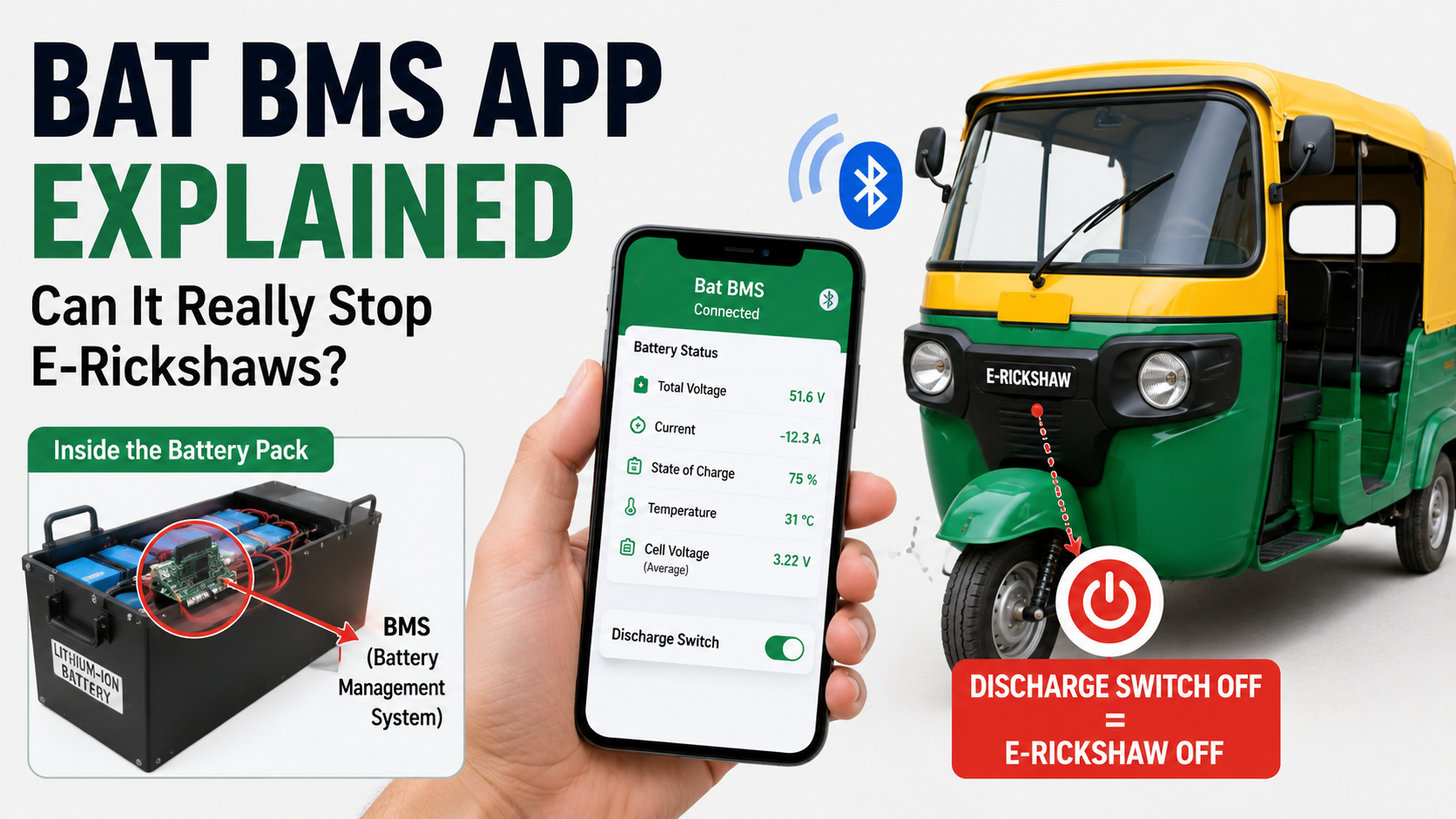
Bat BMS App Explained: Can It Really Stop E-Rickshaws?
Introduction
A viral video showing someone pressing a button on a smartphone and instantly shutting down an electric auto-rickshaw has taken social media by storm. Many viewers believed they were watching a sophisticated hacking attack capable of remotely disabling an electric vehicle. The app featured in the video, known as Bat BMS, quickly became the center of attention, raising questions about whether electric rickshaws can really be “hacked” so easily.
The reality is more technical than sensational. The app does not magically hack vehicles over the internet. Instead, it communicates with the Battery Management System (BMS) found inside many lithium-ion battery packs using Bluetooth. Depending on how the battery is configured and secured, the app may allow certain functions, including disabling battery output.
In this article, we’ll explain how the Bat BMS app works, what a Battery Management System actually does, why Bluetooth is included in some battery packs, and whether this technology represents a useful smart feature or a serious cybersecurity concern.
Prefer a quick visual explanation? Watch my YouTube video where I demonstrate how the Bat BMS app works and explain the viral e-rickshaw incident step by step.
What Is the Viral Bat BMS App?
Bat BMS is a mobile application designed to communicate with compatible Battery Management Systems installed inside lithium-ion battery packs. Its primary purpose is to monitor battery health, display real-time information, and in some cases allow users to configure certain battery settings.
Depending on the battery manufacturer, the app may display:
- Battery voltage
- Current flow
- State of charge
- Cell voltages
- Battery temperature
- Charging status
- Error codes
- Battery health
Many battery manufacturers include Bluetooth connectivity to make diagnostics and maintenance easier without opening the battery enclosure.
Is the Auto-Rickshaw Really Being Hacked?
The viral video makes it appear as though someone remotely hacks an e-rickshaw with a single tap.
In reality, the situation is more nuanced.
The Bat BMS app typically connects directly to the battery’s Bluetooth module. If the battery allows unrestricted access and supports control commands, a connected user may be able to disable battery output through the Battery Management System.
This is not the same as hacking the vehicle’s motor controller or breaking into the vehicle’s software. Instead, it involves communicating with the battery’s built-in management system using its intended interface.
Whether this works depends entirely on the battery manufacturer’s implementation and security settings.
Understanding a Battery Management System (BMS)
The Battery Management System is often described as the “brain” of a lithium-ion battery pack.
It continuously monitors and protects the battery to ensure safe operation.
A BMS performs several critical tasks:
- Monitors voltage of individual cells
- Measures charging and discharging current
- Tracks battery temperature
- Prevents overcharging
- Prevents deep discharge
- Balances individual battery cells
- Detects faults
- Protects against short circuits
Without a BMS, modern lithium-ion batteries would be far less safe and would degrade much more quickly.
Why Lithium-Ion Batteries Need a BMS
Lithium-ion batteries are highly energy-dense, making them ideal for electric vehicles. However, they are also sensitive to operating conditions.
A BMS helps prevent:
Overcharging
Excessive charging can permanently damage battery cells and increase the risk of thermal runaway.
Over-Discharging
Allowing battery voltage to drop too low shortens battery lifespan.
Overheating
High temperatures accelerate battery degradation and can create safety hazards.
Cell Imbalance
The BMS keeps all battery cells at similar voltage levels, maximizing performance and longevity.
How Bluetooth BMS Works
Many modern Battery Management Systems include a Bluetooth module that broadcasts battery information to nearby devices.
Once paired, the companion app can display:
- Live voltage
- Remaining battery percentage
- Cell temperatures
- Charging current
- Fault notifications
- Historical battery data
Bluetooth monitoring eliminates the need for dedicated diagnostic tools and is especially useful for maintenance technicians and fleet operators.
What Are MOSFETs and Why Are They Important?
Inside every smart Battery Management System are electronic switches known as MOSFETs (Metal-Oxide-Semiconductor Field-Effect Transistors).
These components control the flow of electricity into and out of the battery.
Think of a MOSFET as an electronic version of the light switch in your home. Instead of controlling a lamp, it controls power flowing between the battery and the vehicle.
The BMS can command these MOSFETs to:
- Enable charging
- Disable charging
- Enable discharge
- Disable discharge
- Protect the battery during abnormal conditions
This electronic switching happens in milliseconds.
How the Discharge Switch Turns Off an E-Rickshaw
The feature demonstrated in the viral video revolves around the Discharge Switch.
When this switch is disabled:
- The BMS sends a command to the discharge MOSFET.
- The MOSFET interrupts battery output.
- No electrical power reaches the motor controller.
- The e-rickshaw immediately shuts down.
Importantly, this is a built-in safety function originally designed to protect the battery—not to prank or disable vehicles.
Is Bluetooth BMS a Security Risk?
Bluetooth connectivity offers convenience but also introduces potential security concerns.
If manufacturers leave Bluetooth connections unsecured, unauthorized users within Bluetooth range may be able to connect to the battery.
Potential risks include:
- Viewing battery data
- Changing battery settings
- Disabling battery output
- Interrupting vehicle operation
The actual level of risk depends on how securely the manufacturer has implemented Bluetooth authentication.
Can Hackers Actually Control Your EV?
For most modern electric cars from major manufacturers, the answer is no. Automotive-grade systems use multiple layers of security, encrypted communications, and authenticated software.
However, some low-cost e-rickshaw or aftermarket battery packs may use generic Bluetooth modules with weak or no authentication. In such cases, nearby users could potentially connect if proper security has not been implemented.
This is not a universal issue but highlights the importance of secure product design.
Advantages of Smart BMS Systems
Despite the concerns, Bluetooth-enabled BMS technology provides significant benefits:
- Real-time battery monitoring
- Easier diagnostics
- Early fault detection
- Improved battery lifespan
- Better charging management
- Convenient maintenance
- Enhanced user experience
For fleet operators and technicians, these features can reduce downtime and maintenance costs.
Risks of Poorly Secured Bluetooth Devices
Common security weaknesses include:
- Default Bluetooth names
- No pairing password
- Weak authentication
- Outdated firmware
- Lack of encryption
Manufacturers should implement secure pairing methods and encrypted communication to reduce these risks.
Expert Tips
- Only install official BMS apps from trusted sources.
- Change default Bluetooth credentials if possible.
- Keep battery firmware updated.
- Disable Bluetooth when it is not needed.
- Buy batteries from reputable manufacturers with strong security practices.
Common Mistakes
Many users:
- Assume every Bluetooth battery is insecure.
- Confuse battery control with hacking the vehicle.
- Install unofficial BMS apps.
- Ignore firmware updates.
- Leave Bluetooth permanently enabled.
Frequently Asked Questions
What is the Bat BMS app used for?
It is primarily used to monitor and manage compatible lithium-ion Battery Management Systems via Bluetooth.
Can the Bat BMS app really stop an e-rickshaw?
If the battery supports remote discharge control and allows access, the app may disable battery output. This depends on the battery’s design and security settings.
Is Bluetooth BMS dangerous?
Not inherently. When implemented securely, Bluetooth is a convenient monitoring tool. Weak security, however, can create vulnerabilities.
Why does a battery need Bluetooth?
Bluetooth allows users and technicians to monitor battery performance without opening the battery pack.
What is a MOSFET?
A MOSFET is an electronic switch inside the BMS that controls charging and discharging of the battery.
Can someone hack my electric car this way?
Modern electric cars use advanced security systems, making this type of attack highly unlikely. Simpler battery systems with poor security may be more vulnerable.
Should I disable Bluetooth on my battery?
If your battery allows it and you do not need continuous monitoring, disabling Bluetooth can reduce unnecessary exposure.
Key Takeaways
- The Bat BMS app communicates with a battery’s Battery Management System rather than hacking the vehicle itself.
- A BMS protects lithium-ion batteries by monitoring voltage, current, temperature, and cell balance.
- Bluetooth connectivity enables convenient monitoring but must be secured to prevent unauthorized access.
- MOSFETs inside the BMS control battery power and can disable output when instructed.
- Manufacturers should implement strong authentication and encryption to protect Bluetooth-enabled battery systems.
Conclusion
The viral Bat BMS video highlights how easily advanced battery technology can be misunderstood. While it may look like someone is remotely hacking an electric auto-rickshaw, the app is actually interacting with the Battery Management System through its intended Bluetooth interface. If a battery lacks proper security, this convenience feature can become a vulnerability.
As electric vehicles become more connected, manufacturers must strike the right balance between usability and cybersecurity. Strong authentication, encrypted communication, and secure firmware updates are essential to ensure that smart battery features remain both helpful and safe.